- Home
- Knee Surgery
Knee Operation
Written By: Chloe Wilson, BSc(Hons) Physiotherapy
Reviewed by: KPE Medical Review Board
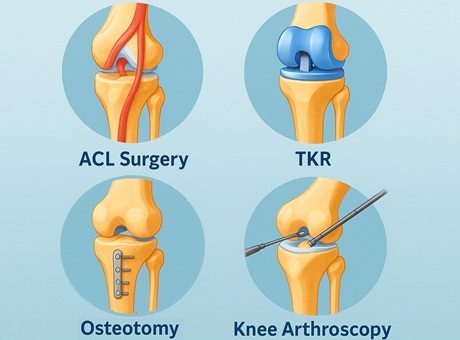
Knee operations are extremely common and usually very effective for a whole range of conditions.
Surgery may be fairly minor, such as keyhole surgery to clean out the joint, or more major, such as replacing the entire knee joint.
People are often understandably nervous about having a knee operation but in most cases, surgery is extremely successful and people make an excellent recovery.
Surgery may be appropriate for repairing damage to the knee ligaments, cartilage or bone, or a combination of these. You may be in and out the same day, or you may need to stay in hospital for a few days, depending on the surgery.
All surgery will be followed by a rehab program to ensure that you get the best results and make a full recovery.
Here we will look the most common knee operations performed including what surgery involves, the most common problems and risks associated with surgery, what rehab involves afterwards and how to make a full recovery.
Common Knee Operations
1. ACL Surgery
The anterior cruciate ligament (ACL) sits in the middle of the knee joint and is responsible for controlling knee stability.
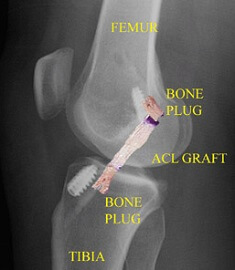
It can be injured either through direct contact injuries or awkard twisting movements of the knee. This can result in either a partial tear or complete rupture of the tendon.
Many people manage to function perfect well with a damaged ACL, but other people have ongoing instability and pain. If this is the case after intensive rehab, a knee operation may be required.
If the ACL is partially torn it can be repaired, if it is completely ruptured, an ACL Reconstruction may be required.
In the ACL injuries section, you can find out loads more including when surgery is appropriate and what it involves, the rehab and recovery process and common problems following surgery..
2. Total Knee Replacements
A total knee replacement is where the knee joint is replaced with a metal and plastic implant, usually due to severe arthritis.
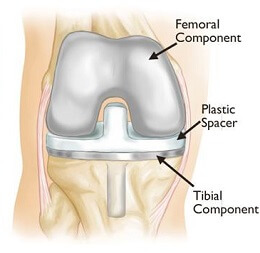
Arthritis is caused by wear and tear of the bones and cartilage which leads to stiffness, pain and weakness.
A knee replacement is usually carried out if you are in severe pain, or your sleep is affected and a rehab programme has failed to help.
In this section you can find out if you would benefit from a knee replacement, what the surgery involves, lots about the rehab and recovery and the common problems associated with this knee operation.
You will also find answers to the most common questions on knee replacements.
3. Partial Knee Replacements
When arthritis is confined to one side of the joint, only part of the knee needs to be replaced. One of the big advantages of this is that you keep all your knee ligaments.
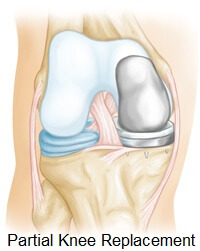
There is very strict criteria to assess whether a partial knee replacement is suitable, but as a result they have extremely good success rates.
People are usually discharged home from hospital very quickly and they tend to make excellent recoveries.
In this section you can find out about what actually happens during partial knee replacement surgery, including all about the recovery process including how quickly you can start doing things, the most common problems associated with the surgery.
You can also find answers to the most common questions about partial knee replacements.
4. Lateral Release
Lateral release knee surgery is used to treat patella maltracking.
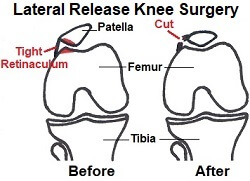
Surgery is performed when the structures on the outer side of the knee tighten and pull the kneecap out of place. This causes the patella to tilt or glide laterally which prevents it from gliding smoothly in the patellar groove at the front of the knee joint.
Tightness usually develops after an injury or due to muscle imbalance and is a common cause of anterior knee pain.
During surgery, the tight structures are released (cut) to allow the patella to return to its normal position.
You can find out what happens during surgery, all about the recovery process and the alternatives to surgery in the lateral release knee surgery section.
5. Knee Arthroscopy
An arthroscopy is the most common knee operation carried out. Keyhole surgery is performed to look inside the joint and wash out any debris.
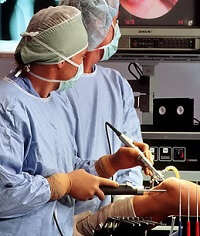
This is usually done when there is damage to the cartilage that lines the knee joint, either due to a meniscus tear or arthritis.
It is a simple procedure that is usually done as a day case, despite being carried out under general anaesthetic. People can usually get up and about immediately, although they may need crutches for a couple of days.
Regular exercises should be done to keep the knee moving properly, and ice can be used to reduce any post-op pain and swelling.
A knee arthroscopy can be combined with a meniscectomy, where any damaged cartilage is removed.
6. Knee Osteotomy
This is where a small amount of bone are removed around the knee. It may be done for conditions such as Osgood Schlatters Disease and is usually carried out arthroscopically.
Recovering From Knee Surgery
The recovery process from each type of operation will vary and you can find detailed advice depending on which type of knee operation you are having by visiting the sections above.
Here's some general advice to get you started though. With any surgery, there are things you can do to reduce pain, bleeding and swelling all of which will help to improve recovery:

- Ice: Using Ice regularly after a knee operation helps to reduce the amount of bleeding and swelling into the joint. There are a number of different ways to apply ice - visit the ice wraps section.
It is extremely important that ice therapy is used safely and effectively - visit the ice section to find out more. - Exercises: After a knee operation it is important to get the knee moving quickly to prevent any stiffness and weakness developing. Your physical therapist should go through a rehab program with you.
- Attitude: A positive attitude can make a real difference. Our mood affects how we experience pain.
You can find out loads more about how to make a full recovery from each type of knee operation in the relevant sections highlighted above.
What Next?
If you want to find out more about knee operations, choose the appropriate sections above to find out more about each type of operation, including information on knee surgery recovery, common questions about the different types of surgery and post-op pain information.
If you need some help working out what is wrong with your knee, visit the knee pain diagnosis section.
You may also be interested in the following articles:
- Medial Knee Pain
- Burning Knee Pain
- Knee Pain From Running
- Knee Locking
- Knee Treatment Options
- How To Do Stairs With Knee Pain
Related Articles


Last Updated: April 30th, 2025
Next Review Due: April 30th, 2027

Check Out Our Book!


Visitor Comments
“This is one of the best self-help & info sites of any medical condition I've ever seen. Excellent work.” Amy, UK
"Your site and exercises have been a lifesaver! The explanations are so clear. Thanks for your help and excellent work." Claire, US
"I LOVE your website. Out of all the others, yours is so informational and easy to read." Michelle, US
"This is the best site dealing with knee problems that I have come
across. I will be putting the stretches and exercises into practise. Thank you!"
Margaret, S. Africa
"Brilliant website - highly recommended! And as nurse (25yrs exp) its written expertly and is very explanatory and easy to understand. Thank you!" Jo, UK
The material on this website is intended for educational information purposes only. It should not substitute or delay medical advice, diagnosis or treatment.
Knee-Pain-Explained.com is a trading name of Wilson Health Ltd. All rights reserved. Terms & Conditions apply
© knee-pain-explained.com 2010-2026. Last updated 6th January 2026
Contact Us About Us Blog Privacy Policy Advertising Policy Sitemap
