- Home
- Common Knee Injuries
- Ligament Sprain
Knee Sprain
Written By: Chloe Wilson, BSc(Hons) Physiotherapy
Reviewed by: KPE Medical Review Board
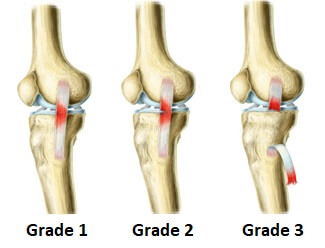
A knee sprain, aka "ligament tear" or "knee strain", is where one of the four knee ligaments overstretches and potentially tears.
Typical symptoms of a sprained knee include ligament pain, swelling, instability, difficulty bending and straightening the knee
The most common cause of a knee sprain is a large force through the knee or sudden twisting of the joint e.g. when sprinting and changing direction
Treatment for a sprained knee will vary depending on the severity of the injury but typically includes PRICE and exercises. Occasionally surgery is required.
Here you can find out everything you need to know about knee sprains including the causes and symptoms of knee sprains, treatment options and the recovery process.
What Is A Knee Sprain?
A knee sprain is where one of the four knee ligaments has been overstretched so far that some or all of the fibres have been damaged.
Knee sprains are usually caused by:
- Direct Force: pushing through the knee e.g. a sporting tackle
- Sudden Twisting: of the knee e.g. when falling awkardly or quickly changing direction
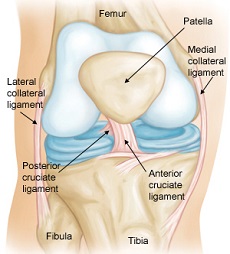
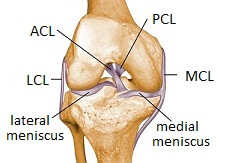
There are four ligaments in the knee joint, any of which can be sprained.
In the centre of the joint are the two cruciate ligaments - anterior and posterior (ACL & PCL). At the sides of the joints are the two collateral ligaments - the medial and lateral (MCL & LCL).
The cruciate and collateral knee ligaments work together to keep the knee joint stable and
protect it from injury.
Common Causes
Any movement that overstretches the knee can result in a knee sprain. It may affect one of more of the ligaments depending on the severity of the injury.
Let's look at the most common causes of a knee sprain and which ligament tends to be affected:
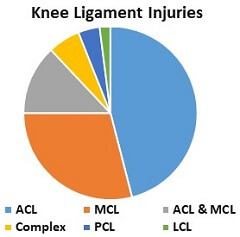
- ACL Sprain: ACL knee sprains are usually caused by sudden twisting of the knee, or hyperextension where the knee bends back too far. Only a minority of ACL knee sprains occur due to contact injuries. ACL Sprains >
- PCL Sprain: A force through a bent knee is the most common cause of PCL injuries, typically a fall onto a bent knee or car accident where the knee hits the dashboard. PCL injuries account for less than 20% of knee ligament injuries. PCL Sprains >
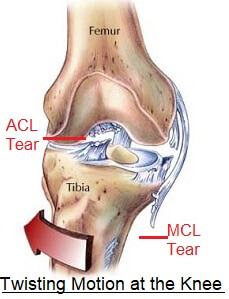
- MCL Sprain: A force through the outer side of the knee pushing the knee inwards, particularly if the foot was fixed to the ground, is the most common cause of an MCL sprain injury. MCL Sprains >
- LCL Sprain: If there was a blow to the inner side of the knee pushing it outwards, then it is likely to have caused a LCL injury
If the force through the knee is great enough, more than one ligament may be damaged, as well as the knee cartilage. The most common knee combination of knee ligament injuries is an ACL and MCL tear.
Ligament Sprain Classification
Ligament injuries can be classified into three knee sprain grades, depending on the amount of damage to the knee ligament:
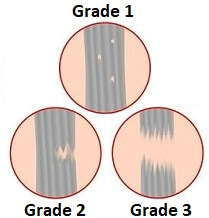
Knee Sprain Grade 1: with a grade 1 knee sprain, only a few fibers, less than 10%, are damaged/torn. Symptoms tend to be fairly mild and the ligament usually heals naturally
Knee Sprain Grade 2: with a grade 2 knee sprain, there is more substantial damage. More of the fibers are torn but the ligament remains partially intact. Moderate symptoms of knee pain, swelling and instability are common
Knee Sprain Grade 3: with grade 3 knee sprains, the ligament ruptures completely. Once the initial swelling and knee pain have settled, there may be ongoing problems of instability which may require surgery
Knee Sprain Symptoms
The most common knee sprain symptoms are pain, swelling, bruising and stiffness which may make it difficult to move the knee and/or walk. With more severe knee injuries, there may also be some instability around the knee causing it to give way.
Knee sprain symptoms may develop immediately after an injury, but sometimes they don’t appear until a couple of days later.
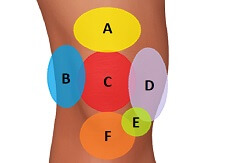
The location of the pain can help to determine which knee ligament you have sprained.
- Medial Knee Pain: pain on the inner side of the knee usually indicates a Medial Collateral Ligament tear - see MCL Tear
- Lateral Knee Pain: pain on the outer side of the knee usually indicates a Lateral Collateral Ligament tear
- Widespread Pain and Instability: If the knee pain is throughout the whole joint and the knee keeps giving way, it is most likely an ACL injury, particularly if there was a "popping" noise" at the time of injury. In rarer cases, it can indicate a PCL tear.
- Severe Swelling: If there is a great deal of swelling, you probably have a grade 3 knee sprain and you may have injured more than one knee ligament
What To Ask Your Doctor

If you are given a diagnosis of a sprained knee, it is worth asking some questions to find out more.
You want to find out from your doctor:
- Which ligament is damaged?
- What grade knee sprain is it?
- What treatment do they recommend?
- Is there anything you need to avoid?
- Is it safe to drive?
Knee Sprain Treatment
Knee sprain treatment initially focuses on reduce knee pain and swelling. Longer term treatment for a knee sprain will focus on regaining strength and stability at the knee to reduce the risk of further knee injuries.
1. PRICE
Usually, the best course of immediate action with a knee sprain is to follow the PRICE principles - Protect, Rest, Ice, Compress, Elevate. This helps to reduce knee pain and swelling and to speed up healing.
Visit the PRICE treatment section to find out how to safely and effectively use all the different aspects.
2. Knee Rehab
After a few days, once you can comfortably start moving your knee, you can start some exercises to regain the strength, movement and function of your knee. Exercises are really important after a knee sprain to make sure you make a full recovery and don't leave yourself at risk of further injuries due to ongoing instability.
A combination of exercises for the different groups of the knee muscles works best. You can find in-depth guidance on
exercises and how to progress them appropriately to get back to full
function following a sprain visit the
knee strengthening exercises
section.
3. Knee Brace
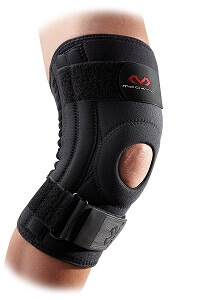
After a knee sprain, you may find that wearing a knee brace helps to reduce any pain and instability.
With a knee sprain grade 1, a basic knee brace will be sufficient, costing as little as $4/£7. If you need a bit more support, advanced knee braces work well. There is a massive range of knee sprain braces out there, with different styles, support levels, and materials. We can help you work out which one is right for you.
If you have already been discharged by your doctor and all you have been told is that you have a sprained knee, it is almost certainly not too serious, and is likely a grade 1 or 2 sprain.
Grade 3 tears (also known as a rupture), can often be treated in the same way as grade 1 & 2 knee sprains, although they will take longer to heal. If there is major instability, i.e. the knee keeps giving way, an elite knee brace can help to provide stability and prevent further knee injury.
However, sometimes surgery is advisable if the knee keeps giving way, despite trying exercises.
4. Surgery
Whilst most knee sprains will heal naturally with the right combination of rest and exercises, this is not always the case.
People who have had a grade 3 knee sprain often have ongoing problems with knee instability. Anytime the knee gives way, there is a risk of damage to the knee joint and cartilage so it is really important to prevent that from happening.
If after a few months of diligently doing exercises and wearing a knee brace the knee continues to give way, then surgery may be necessary. The most frequent grade 3 knee sprain to require such is the ACL - you can find out loads more in the ACL knee surgery section.
Knee Sprain Recovery Time
Knee sprain recovery time will depend on what grade sprain you have suffered and which ligament has been damaged. As a general rule:
- Grade 1: recovery usually takes around 2 weeks
- Grade 2: recovery time is usually 2-6 weeks
- Grade 3: recovery time can be anything from 3 months to a year. Collateral ligament ruptures (MCL or LCL) generally heal much faster than cruciate ligament tears (ACL or PCL).
What Else Can Help?
The most common knee ligaments to sprain are the MCL and ACL. The least common is a PCL injury.
You can find out more about these including more in-depth information on the causes, symptoms and treatment options for these knee sprains:
Page Last Updated: 10/01/23
Next Review Due: 10/01/25
Related Articles


Check Out Our Book!


Visitor Comments
“This is one of the best self-help & info sites of any medical condition I've ever seen. Excellent work.” Amy, UK
"Your site and exercises have been a lifesaver! The explanations are so clear. Thanks for your help and excellent work." Claire, US
"I LOVE your website. Out of all the others, yours is so informational and easy to read." Michelle, US
"This is the best site dealing with knee problems that I have come
across. I will be putting the stretches and exercises into practise. Thank you!"
Margaret, S. Africa
"Brilliant website - highly recommended! And as nurse (25yrs exp) its written expertly and is very explanatory and easy to understand. Thank you!" Jo, UK
The material on this website is intended for educational information purposes only. It should not substitute or delay medical advice, diagnosis or treatment.
Knee-Pain-Explained.com is a trading name of Wilson Health Ltd. All rights reserved. Terms & Conditions apply
© knee-pain-explained.com 2010-2026. Last updated 26th March 2026
Contact Us About Us Blog Privacy Policy Advertising Policy Sitemap
