- Home
- Knee Pain Diagnosis
Knee Pain Diagnosis
Written By: Chloe Wilson, BSc(Hons) Physiotherapy
Reviewed by: KPE Medical Review Board
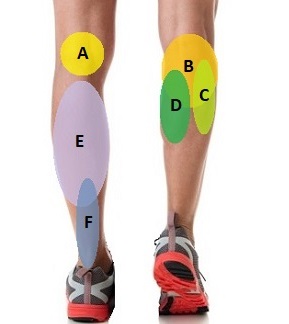
Accurate knee pain diagnosis is the first step in recovering from a knee problem so you can beat your pain and stop it from coming back again.
There are lots of different things that can cause knee pain, which all need to be treated slightly differently.
Here, we will help you to work out what is causing your pain so you treat it effectively and make a quick recovery.
There are three ways to approach knee pain diagnosis:
- The Location of the Pain: where exactly your knee pain is e.g. front, side or back
- How the Pain Started: the mechanism of injury e.g. sudden twisting or gradual onset
- Your Specific Symptoms: what are the main symptoms associated with your pain e.g. popping noises, locking
Knee Pain Diagnosis by Location
People often find the simplest place to start with knee pain diagnosis is to think about where their pain is in the knee. While pain can refer to and from other places, thinking about where the majority of the pain is coming from can help with working out what has gone wrong.
1. Front Knee Pain

The front of the knee is the most common place to get knee pain, commonly referred to as anterior knee pain.
Front knee pain can be caused by a number of knee problems, often related to the kneecap such as Runners Knee and Plica Syndrome.
There may also be inflammation, tearing, degeneration and muscle imbalance.
Visit the Front Knee Pain diagnosis section to find out what problems cause pain here and how best to treat them.
2. Inner Knee Pain
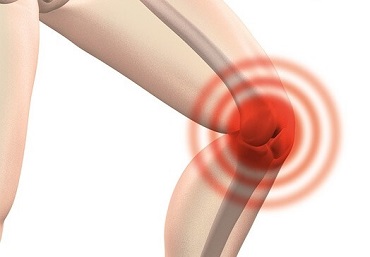
Medial knee pain on the inner side of the knee is extremely common.
This is because more force tends to go through the inner side of the knee (the side closest to the other leg) than the outer side.
This places the medial structures under more stress making them prone to injuries such as MCL tears and meniscus tears.
If your pain is mostly on the inner side of your leg, check out the Medial Knee Pain diagnosis section to find out about the common causes and treatment options.
3. Pain Behind the Knee
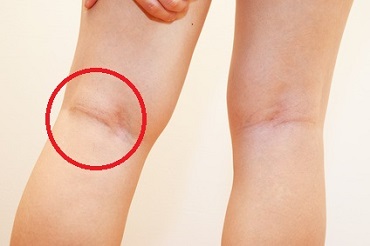
Pain at the back of the knee is most common in the over 50’s from wear and tear or inflammatory conditions such as arthritis or a Bakers Cyst.
In younger people, pain behind the knee tends to be due to knee injuries such as a hyperextended knee or posterior ligament injury.
Occasionally pain behind the knee can be a sign of something serious, such as a DVT, so accurate knee pain diagnosis is really important
If your pain is mostly behind your knee, visit the Posterior Knee Pain diagnosis section to learn about the different causes and treatments.
4. Outer Knee Pain
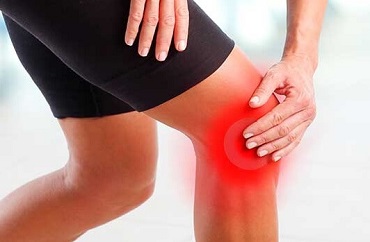
The outer side of the knee is the least common place to have problems as less force goes through that side of the joint.
Lateral knee pain is usually caused by irritation and damage to the structures on the outer side of the knee such as the ITB or lateral meniscus.
If that is where your knee pain is, go to the Lateral Knee Pain diagnosis section to find out about the main causes and how to treat them.
5. Pain Above Knee
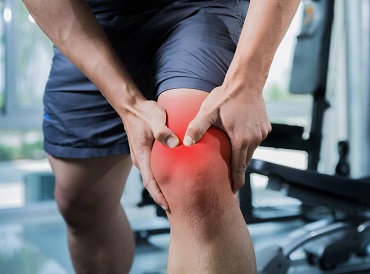
Pain above the knee is a common problem. There may be pain right above the knee/kneecap or lower thigh pain.
Top of knee pain is usually caused by a problem in the soft tissues of the lower thigh, particularly the quadriceps and the ITB, but can also be due to bone problems e.g. arthritis and soft tissue inflammation e.g. bursitis.
In your pain is mostly above the knee or in the lower thigh, check out the Above Knee Pain diagnosis section to find out all about the common causes of top of knee pain and how to treat them. If your pain is higher up, have a look at the Upper Thigh Pain section.
6. Pain Below Knee
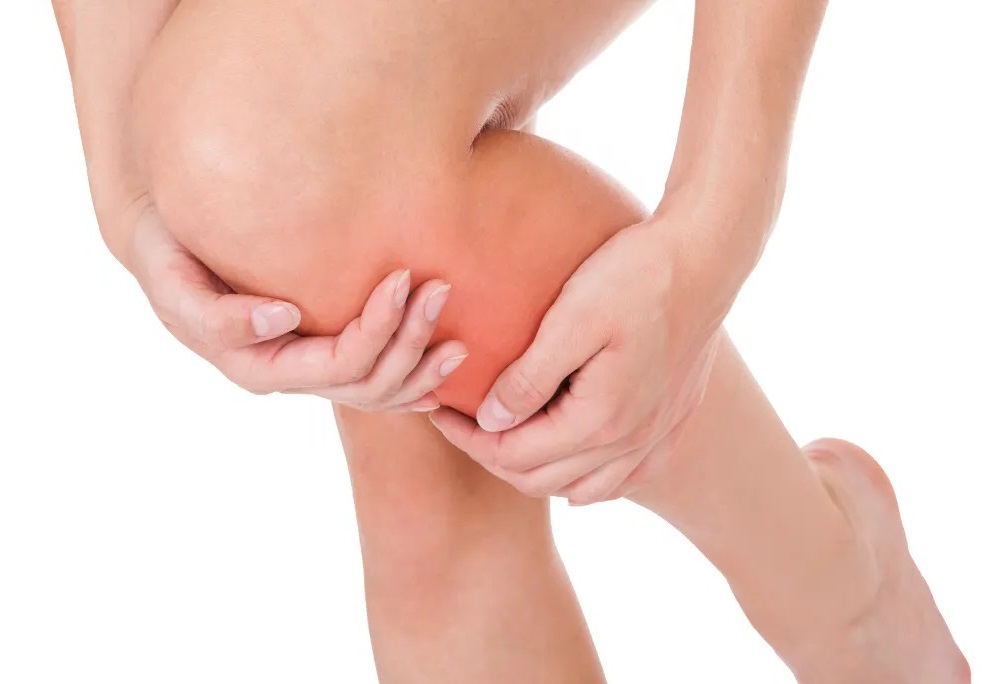
Pain below the knee may be right under the knee cap, further low the leg in the shin or in the back of the calf.
There are a number of different things that cause pain below the knee, but many of them are linked to overuse in sporting activities that involve lots of running, kicking or jumping.
Inflammation and degeneration of soft tissues and bone results in leg pain under the knee e.g. tendonitis, bursitis and bone spurs.
If your pain is mainly focused underneath the knee joint or in the shin or calf, visit the Below Knee Pain diagnosis section to find out what is causing your pain and how best to treat it.
7. Calf Pain
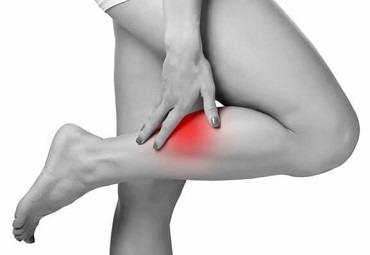
Most cases of calf pain are caused by soft tissue damage from an injury such as a muscle tear. Overuse and muscle imbalance often contribute to calf pain.
However in some cases pain in the calf is due to something more serious such as a deep vein thrombosis (DVT) - a blood clot in the leg which requires immediate medical attention.
In the Calf Pain section we look at the most common causes of pain in the calf region, how they vary, how to tell if it's serious and how to treat them.
8. Knee Cap Pain
Huge forces go through the kneecap during everyday activities e.g. stairs and squatting. It is lined with the thickest layer of cartilage in the body as a result but is still prone to damage.
Knee cap pain may come on gradually from overuse or wear and tear such as in patellar tendonitis, or suddenly from an injury such as a kneecap dislocation.
Visit the Knee Cap Pain section to find out more about the different causes, symptoms and treatment options for patella problems.
9. Hip Pain
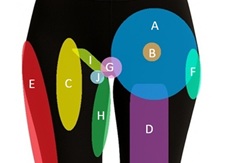
Problems in the hip joint often cause outer hip pain, front hip pain, inner thigh pain or top of thigh pain that radiates down the thigh towards the knee.
There may be a problem in the hip bones, such as arthritis, hip impingement or osteitis pubis, the soft tissues such as labral tears or hip bursitis, or the muscles, such as tendonitis, snapping hip syndrome or a muscle strain.
If you are more a visual person, then check out our knee pain diagnosis chart.
Knee Diagnosis By Onset
Another important part of knee pain diagnosis is knowing whether the problem started suddenly, which usually indicates a specific knee injury, or whether it came on gradually over time for no specific reason, which usually indicates an underlying knee condition.
1. Twisted Knee
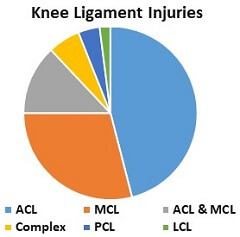
A twisted knee is one of the most common knee injuries. This type of injury most commonly occurs during sports or by falling awkwardly. Depending on how the knee twists, it places stress through different structures of the knee so accurate knee pain diagnosis is vital.
Most commonly, it is the ligaments or cartilage that get damaged when the knee over-twists. Ligament injuries tend to cause ongoing problems with stability and the knee may frequently give way even months after the initial injury.
Cartilage knee injuries tend to cause pain and swelling, may limit knee movement and at times can cause the joint to get stuck. In more serious injuries, multiple structures may be damaged.
You can find out more about making an accurate knee pain diagnosis for these different knee injuries and how to treat them in the Twisted Knee section.
2. Hyperextended Knee
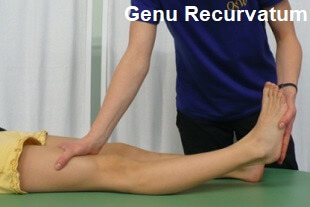
Knee hyperextension is a common knee injury in sports where the knee bends back too far, known as genu recurvatum.
This can damage the knee joint and surrounding structures and results in pain, swelling and instability.
The knee ligaments are very strong and work together to keep the joint strong, but if the knee is suddenly forced backwards, the knee over-straightens back into hyperextension and the ligaments are put under considerable strain.
This may be from a sporting tackle, landing awkwardly from a jump, coming to a sudden stop when running, or even something as simple as someone jumping on your back.
In the hyperextended knee section you can find out exactly what happens to the different joint structures when it hyperextends, help you to make an accurate knee pain diagnosis as to what you have done, the common symptoms, how to treat it and how to make a full recovery.
3. Pain Gradually Came On
A gradual onset of knee pain usually indicates an underlying problem that may have been there for a while without you realising.
Sometimes the knee will cope with a developing problem for so long, and then for no obvious reason will start being uncomfortable. It may be knee arthritis, tendonitis, bursitis or wear and tear
In the Common Knee Conditions section we look at common knee problems, what causes them, typical knee symptoms and how to treat them.
4. Sudden Knee Pain
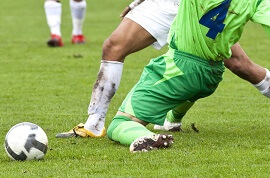
Knee injuries are often caused by:
- A Force Through The Knee e.g. from a fall or a tackle or
- Sudden Deceleration e.g. stopping suddenly causing the leg to bend too far backwards
- Twisting e.g. skiing
These most commonly result in knee injuries to the ligaments and/or cartilage. Pain is usually instant, or certainly comes on within 24-48 hours and may be accompanied by swelling and bruising.
Visit the Common Knee Injuries section to find out more including symptoms and treatment options for different injuries to help you make an accurate knee pain diagnosis.
Knee Symptoms Diagnosis
Often, it is helpful to think about your specific knee symptoms when diagnosing knee pain such as what activities cause pain or what it actually feels like
The pain may be quite widespread or move around, in which case, thinking about how the pain affects you, when you get it and what it stops you from doing might be easier than where the pain is for making a knee pain diagnosis.
There are a whole range of symptoms associated with knee pain that can help you to make an accurate knee pain diagnosis such as:
- Knee Swelling
- Instability & Giving Way
- Knee Pain When Running, Kneeling or Bending
- Strange Knee Noises
- Knee Pain On Stairs
- Burning In The Knee
- Knee Pain At Night
- Sharp Knee Pain
In the knee symptoms section we look at these and other common symptoms associated with knee problems and what they mean.
Why Is Diagnosis So Important?
The most common reason for knee pain to recur is failure to treat the underlying cause of a problem, usually due to an inaccurate knee pain diagnosis.
For example, let's say your knee is swollen. You can treat the swelling with ice, compression bandages, elevation and exercises and the swelling will most likely start to improve. But chances are, your knee problems will come back again unless you have identified what caused the swelling in the first place and treated that too.
Successful treatment isn't just about getting the knee pain to stop, it's also about making sure it doesn't come back!
More About Knee Pain Diagnosis
So here we have looked at how to make a knee pain diagnosis by the location or onset of the pain. You can find out everything you need to know about each of these knee problems by using the links above. You may not find the right things first time, but by using these tools, you will get there.
Alternatively, have a look at our knee pain diagnosis chart. Or if your pain is further up your leg, check out our hip pain diagnosis charts.
If you have specific symptoms associated with your pain e.g. the pain is sharp or burning, or there is instability or swelling visit the knee symptoms guide.
If you want to know how to get rid of your pain, visit the knee pain treatment section for a variety of treatment options.
But remember, the best way to get an accurate knee injury diagnosis is to see your doctor/physical therapist.
Related Articles

Last Updated: June 10th, 2025
Next Review Due: June 10th, 2027
Check Out Our Book!


|
 |
This site complies with the HONcode Standard |
Visitor Comments
“This is one of the best self-help & info sites of any medical condition I've ever seen. Excellent work.” Amy, UK
"Your site and exercises have been a lifesaver! The explanations are so clear. Thanks for your help and excellent work." Claire, US
"Your website is a gold mine, thank you very much."
Gavril, Denmark
"I LOVE your website. Out of all the others, yours is so informational and easy to read." Michelle, US
"This is the best site dealing with knee problems that I have come
across. I will be putting the stretches and exercises into practise. Thank you!"
Margaret, S. Africa
"Brilliant website - highly recommended! And as nurse (25yrs exp) its written expertly and is very explanatory and easy to understand. Thank you!" Jo, UK
The material on this website is intended for educational information purposes only. It should not substitute or delay medical advice, diagnosis or treatment.
Knee-Pain-Explained.com is a trading name of Wilson Health Ltd. All rights reserved. Terms & Conditions apply
© knee-pain-explained.com 2010-2025. Last updated 2nd July 2025
Contact Us About Us Blog Privacy Policy Advertising Policy Sitemap
