- Home
- Knee Pain Diagnosis
- Diagnosis Chart
Knee Pain Diagnosis Chart
Written By: Chloe Wilson, BSc(Hons) Physiotherapy
Reviewed by: KPE Medical Review Board
A knee pain diagnosis chart is a simple but powerful way to narrow down what’s causing your knee pain based on where the pain is felt.
Different structures around the knee — tendons, ligaments, cartilage, bursae and bones — tend to cause pain in predictable locations.
By matching the location of your knee pain with your symptoms, you can get a much clearer idea of what’s going on and what to do next.
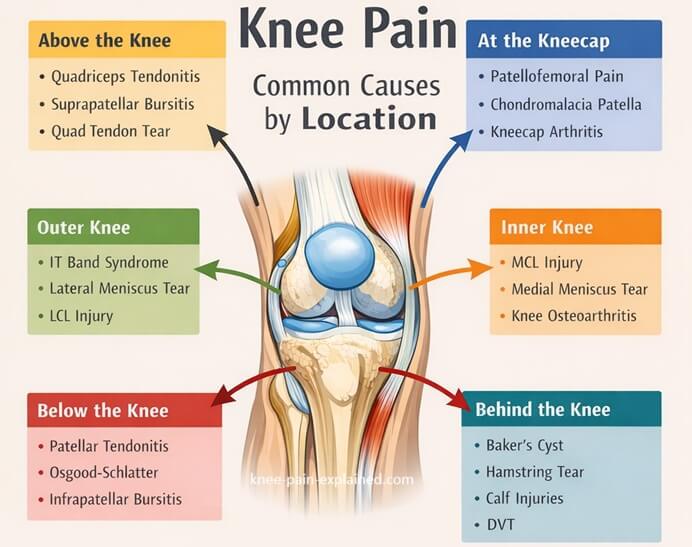
How to Use a Knee Pain Diagnosis Chart
Follow these three steps:
- Identify the exact location of your pain
- Note your key symptoms (swelling, locking, instability, stiffness)
- Match them to the chart below
Pain location alone is often enough to narrow things down to 2–3 likely conditions, which can then be confirmed with a clinical assessment if needed.
We have created two detailed knee pain location charts to help you pinpoint the cause of your pain more accurately:
- Front Knee Pain Location Chart: pain at the front and sides of the knee
- Posterior Knee Pain Location Chart: pain and swelling at the back of the knee and down into the calf
If your pain is further down your leg towards your ankle or foot, check out this Foot Pain Diagram, or if it is further up your leg, have a look at our Hip Pain Location Diagrams.
Front Knee Pain Diagnosis Chart
This first knee pain diagnosis chart focuses on pain at the front and sides of the knee.
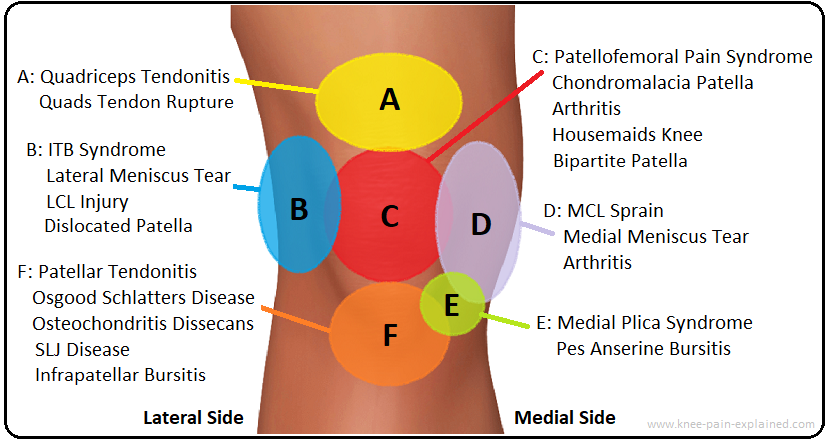
A. Pain Above the Knee Cap
Pain above the knee cap in the lower thigh is usually caused by:
- Quadriceps Tendonitis: Damage to the quadriceps tendon causing pain above the kneecap that is worse with activity
- Quads Tendon Rupture: A partial or complete tear of the quads tendon. A rare, but serious injury
- Supapatellar Bursitis: inflammation of the causing pain and a soft pocket of swelling above the knee
If your pain is further up the leg, check out the upper thigh pain article.
B. Outer Knee Pain
Lateral knee pain on the outer side of the knee may be caused by:
- Iliotibial Band Syndrome: Most common. Irritation of the thick band on the outer leg. Pain may be extend up towards the hip on the outer thigh.
- Lateral Meniscus Tear: Damage to the lateral portion on the knee cartilage. Can make it difficult to straighten the knee.
- Lateral Collateral Ligament Injury: Overstretching and tearing of the LCL usually from awkward knee twisting or a large force through the side of the knee.
- Dislocated Patella: Where the kneecap shifts out of the patella groove causing an obvious deformity.
If your pain is further up the leg, check out the outer thigh pain article.
C. Pain At The Kneecap
Front knee pain around the knee cap may be caused by:
- Patellofemoral Pain Syndrome: Most common. Caused by a problem with how the kneecap moves.
- Chondromalacia Patella: Damage to the cartilage on the back of the kneecap. Typically affects healthy people under the age of 40.
- Arthritis: Wear and tear or degeneration of the knee bones and cartilage. Typically affects over the 60's.
- Housemaids Knee: Inflammation of the prepatellar bursa, often causing localised swelling at the front of the knee. Can occur at any age, most commonly in people who spend lots of time kneeling.
- Bipartite Patella: Where the kneecap bone is in two pieces, having failed to fuse during childhood.
D. Inner Knee Pain
Medial knee pain on the inner side of the knee may be caused by:
- Medial Collateral Ligament (MCL) Sprain:Most Common. Overstretching or tear of the MCL from knee twisting injury. Typically affects the under 50's.
- Medial Meniscus Tear: Damage to the knee cartilage either through injury (typically under 50's) or wear and tear (typically over 50's). Often associated with knee locking and swelling.
- Arthritis: Gradual onset of knee pain due to wear and tear of the knee cartilage and bones. Typically affects the over 60's and more common on inner side of the knee than the outer.
If your pain is further up the leg, check out the inner thigh pain article.
E. Medial Pain Below The Knee
Medial knee pain just below the knee is usually caused by:
- Medial Plica Syndrome: Inflammation of the synovial membrane in the knee joint. Often associated with knee clicking.
- Pes Anserine Bursitis: Inflammation of the pes anserine bursa. Pain felt approximately 2 inches below the knee, often associated with a pocket of swelling.
F. Pain Below The Knee
Pain below the knee at the front of the shin may be caused by:
- Patellar Tendonitis: Most common. Damage to the patellar tendon, thickening of the tendon, pain worse with repetitive activities e.g. jumping.
- Osgood Schlatters Disease: Affects adolescents and children typically after a growth spurt. Pain is felt at the top of the shin bone and there is often a hard bony lump.
- Infrapatellar Bursitis: Inflammation and swelling of the bursa forming a squashy lump just below the kneecap.
- Osteochondritis Dissecans: Decreased blood flow to the knee bones leads to degeneration, thinning and tearing of the knee bones and cartilage. Most common between the ages of 10-20.
- Sinding-Larsen-Johansson (SLJ) Disease: Affects adolescents and children. Pain similar to OSD but slightly higher, just below the kneecap.
Posterior Knee Pain Location Chart
Our second knee pain diagnosis chart focuses on the causes of pain at the back of the knee.
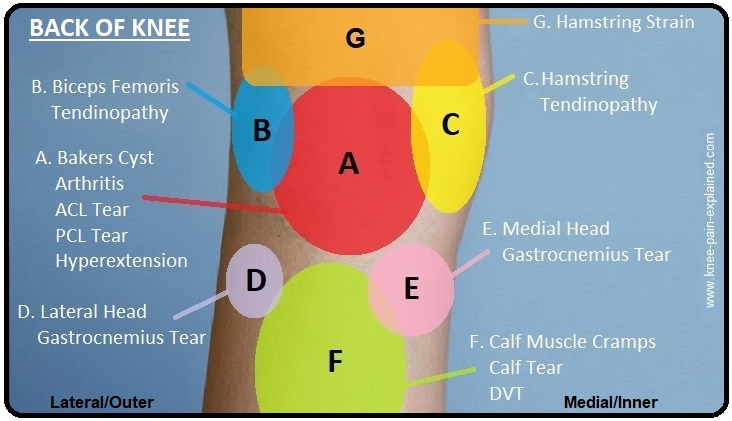
A. Pain Behind The Knee
Pain behind the knee may be caused by:
- Bakers Cyst: Most common cause of pain and swelling behind the knee. Inflammation of the popliteal bursa.
- Arthritis: Degeneration of the knee cartilage and bones causing pain and stiffness, especially in the morning.
- ACL Tear: Injury to the anterior cruciate ligament from twisting or force through the knee. Usually associated with knee instability.
- PCL Tear: Injury to the posterior cruciate ligament - less common than ACL Injury. Typically injured in RTA, fall or sports.
- Hyperextension Injury: Where the knee bends too far backwards causing pain, swelling and restricted movement.
B. Posterolateral Knee Pain
Outer knee pain at the back of the knee is most typically due to:
- Biceps Femoris Tendinopathy: Inflammation, degeneration or a tear in biceps femoris, one of the hamstrings muscles. Common problem for runners, frequently misdiagnosed as ITBS.
C. Posteromedial Knee Pain
Inner knee pain at the back of the knee is usually caused by:
- Hamstring Tendinopathy: Inflammation or degeneration of the two hamstring muscles on the inner side of the knee (semimembranosus or semitendinosus) from repetitive overuse. Usually affects runners, cyclists, footballers or climbers.
D. Lateral Pain Below The Knee
Pain on the outer side of the calf just below the knee is usually due to:
- Lateral Head of Gastrocnemius Injury: Tear of the lateral head of the superficial calf muscle. Rarely injured in isolation, usually associated with ligaments and/or cartilage damage.
E. Medial Pain Below The Knee
Pain on the inner side of the calf just below the knee is usually due to:
- Medial Head of Gastrocnemius Injury: Tear of the medial head of the superficial calf muscle. Usually injured when the pushing off the foot whilst the knee is straight and the ankle is flexed.
F. Pain Below The Knee
Calf pain below the back of the knee may be caused by:
- Calf Muscle Cramps: Sudden spasming of the calf muscles. May be extremely painful but usually settles within a few minutes.
- Calf Tear: Overstretching or tearing of one of the calf muscles, usually during sports. Typically instant pain with immediate swelling and bruising.
- DVT: A blood clot in one of the deep leg veins. Associated with intense pain, swelling, redness, heat and tenderness. A DVT is a medical emergency and requires immediate medical intervention.
G. Posterior Pain Above The Knee
Pain in the back of the thigh just above the knee is usually caused by:
- Hamstring Strain/Tear: Partila or complete tear of one of the hamstring muscles/tendons anywhere in the back of the thigh.
Hopefully, having looked at the knee pain diagnosis chart information here, you are on your way to working out what is wrong with your knee, now it's a case of fixing it!
Understanding Knee Pain Diagnosis
Understanding what is causing your knee pain is the first, crucial step to overcoming knee pain. The knee pain diagnosis chart options here are very useful visual tools to help you work out what is wrong.
You can find out loads more about these conditions, the causes, symptoms and treatment options, by using the links above. Alternatively, if you want some more guidance, visit the knee pain diagnosis section.
Some useful articles that go alongside our knee pain diagnosis charts are:
- Anterior Knee Pain: front
- Lateral Knee Pain: outer side
- Medial Knee Pain: inner side
- Posterior Knee Pain: behind the knee
- Pain Above Knee: top of knee and lower thigh
- Pain Below Knee: under the knee and in the shin/calf
- Patellar Pain: kneecap
- Calf Pain: lower leg
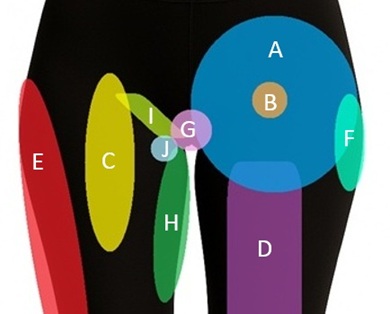
If your pain is higher up towards your hip or thigh, have a look at our hip pain location diagrams or check out the following articles:
- Front Hip Pain: anterior hip
- Outer Hip Pain: lateral hip
- Inner Thigh Pain: inner hip and thigh pain
- Pain At Top Of Thigh: Upper thigh pain
There are lots of other causes of knee pain that don't appear on either of these knee pain diagnosis charts e.g. gout knee and bone spurs. They tend to cause more general, widespread knee pain, rather than pain in a specific locations so haven't been included here on these knee pain location charts. You can find out more about them in the common knee conditions section.
When To See a Doctor for Knee Pain
A knee pain diagnosis chart can be very helpful for narrowing down the likely cause of your symptoms, but there are times when you should not rely on self-diagnosis alone.
You should see a doctor, physiotherapist or other qualified healthcare professional if your knee pain:
Needs Urgent Medical Attention
Seek immediate medical help if you have:
- Sudden, severe knee pain after an injury
- Inability to weight-bear or straighten the knee
- A visibly deformed knee or kneecap
- Rapid swelling, redness, heat or fever
- Calf pain with swelling, warmth or redness (possible DVT)
These symptoms may indicate a fracture, ligament rupture, infection or blood clot, all of which require urgent assessment.
Should Be Assessed But Is Not An Emergency
Arrange a medical review if:
- Knee pain has not improved after 2–3 weeks
- Pain keeps returning despite rest or treatment
- Your knee feels unstable, gives way or locks
- Swelling persists or keeps coming back
- Pain is affecting sleep, work or daily activities
Persistent symptoms often indicate an underlying problem such as tendon injury, cartilage damage or arthritis that benefits from targeted treatment.
Special Situations
You should also seek medical advice if:
- Knee pain occurs in children or adolescents without a clear injury
- Pain develops without any obvious cause
- You have a history of arthritis, gout, inflammatory conditions or previous knee surgery
- Knee pain is associated with unexplained weight loss or feeling generally unwell
Early assessment often leads to faster recovery and better long-term outcomes.
Knee Pain Diagnosis FAQs
Let's have a look at some of the most frequently asked questions about knee pain diagnosis.
Can I Diagnose Knee Pain Myself?
Can I Diagnose Knee Pain Myself?
You can make a good initial assessment using symptoms, pain location and activity triggers, but self-diagnosis has limits.
You should not rely on self-diagnosis alone if:
- Pain is severe or worsening
- Swelling persists
- The knee locks, gives way or feels unstable
- Pain does not improve after 2–3 weeks
A physiotherapist or doctor can confirm the diagnosis and rule out more serious conditions.
How Can I Tell What Is Causing My Knee Pain?
How Can I Tell What Is Causing My Knee Pain?
The most reliable way to narrow down the cause of knee pain is by looking at where the pain is located, how it started and what movements make it worse.
- Pain above the kneecap: quadriceps tendon or suprapatellar bursa
- Pain at the kneecap: patellofemoral pain, arthritis or bursitis
- Below the kneecap: patellar tendon, bursitis or growth-related conditions in children
- Inner knee pain: MCL injury, medial meniscus tear or arthritis
- Outer knee pain: IT band syndrome or lateral meniscus injury
- Pain behind the knee: Baker’s cyst, ligament injury or calf strain
This is why knee pain location charts are so useful for diagnosis.
When Should I Get An X-ray Or MRI For Knee Pain?
When Should I Get An X-ray Or MRI For Knee Pain?
You may need an X-ray if you suspect a fracture, arthritis, or after a significant knee injury. MRI may be recommended for persistent symptoms, locking, or suspected ligament/meniscus tears. A healthcare professional will advise the appropriate imaging.
Why Does My Knee Hurt But There Is No Swelling?
Why Does My Knee Hurt But There Is No Swelling?
Not all knee problems cause visible swelling.
Conditions such as:
- Tendonitis
- Early cartilage damage
- IT band syndrome
- Referred pain from the hip or back
can cause significant pain without obvious swelling.
Can Knee Pain Come From Somewhere Else?
Can Knee Pain Come From Somewhere Else?
Yes. Knee pain is sometimes referred pain, meaning the problem originates elsewhere.
Common sources include:
- The hip joint
- The lower back
- Tight or weak thigh muscles
- Altered walking or running mechanics
If knee pain does not fit a typical pattern, these areas should be assessed.
Is Knee Pain Always Caused By Injury?
Is Knee Pain Always Caused By Injury?
No. Many knee problems develop gradually rather than from a single injury.
Common non-traumatic causes include:
- Overuse
- Muscle imbalance
- Poor biomechanics
- Arthritis
- Inflammatory conditions
This is why knee pain can appear even without a clear cause.
What Else Can Help?
These knee pain diagnosis charts are a great place to start when it comes to working out what is wrong with your knee, but what do you then do about it? You'll find loads of great information about each of these knee problems, and more, using the links above.
Alternative, following multiple requests from our readers, we have recently published our second book, "Beat Knee Pain: Take Back Control".
It tells you everything you need to know to help you work out what is wrong with your knee and gives you loads of great advice on how to get back to doing what you love. You'll find all the information from this site and loads more. We know many people prefer having the information is book form so they can navigate through easily, so do check it out.
Beat Knee Pain: Take Back Control has an average rating of 4.6/5 and is ranked the #2 Best Seller in Orthopedics on Amazon*.
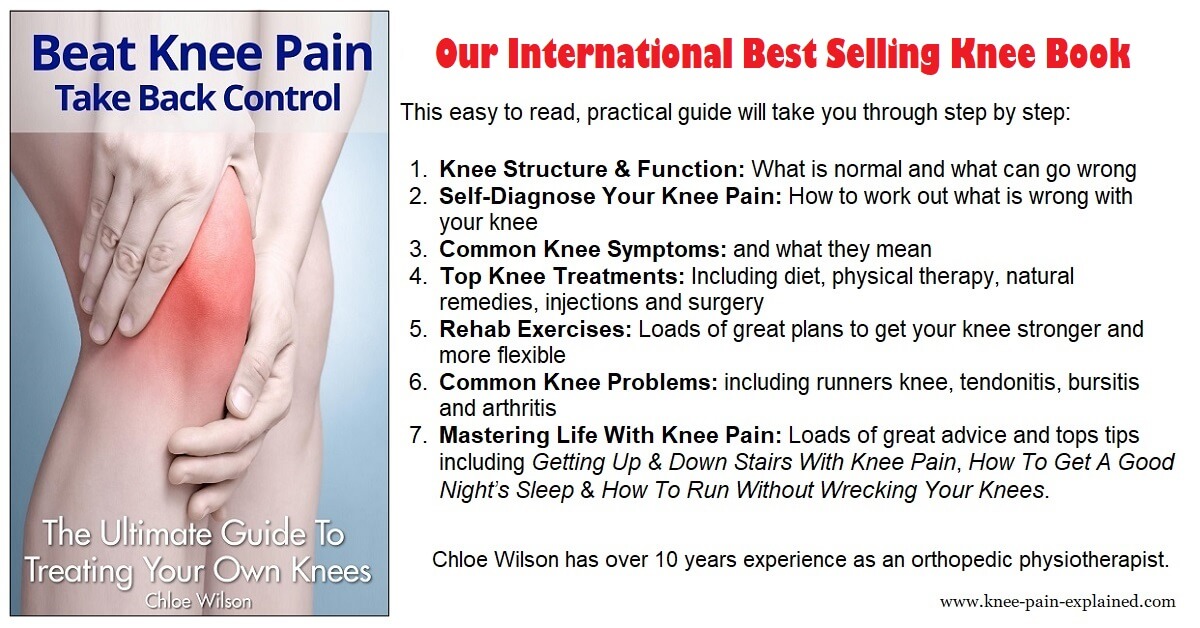
*Ranked #2 Best Seller in Orthopedics (Kindle Store) on Amazon.com in October 2021
Knee pain location charts are just the start. Now that you've got a good idea what is going on, it's time to start fixing it so you can get back to the things you love.
Related Articles

References
American Family Physician Journal. Evaluation of patients presenting with knee pain: Part II. Differential diagnosis. September 2003
British Medical Journal Best Practice. Assessment of Knee Injury. June 2018
Medscape. Evaluating Knee Pain: The Latest in Diagnosis and Management. June 2017
National Institute for Healthcare & Excellence (NICE). Knee Pain - Assessment. August 2022
Last Updated: June 9th, 2026
Next Review Due: June 9th, 2026

Check Out Our Book!

Visitor Comments
“This is one of the best self-help & info sites of any medical condition I've ever seen. Excellent work.” Amy, UK
"Your site and exercises have been a lifesaver! The explanations are so clear. Thanks for your help and excellent work." Claire, US
"I LOVE your website. Out of all the others, yours is so informational and easy to read." Michelle, US
"This is the best site dealing with knee problems that I have come
across. I will be putting the stretches and exercises into practise. Thank you!"
Margaret, S. Africa
"Brilliant website - highly recommended! And as nurse (25yrs exp) its written expertly and is very explanatory and easy to understand. Thank you!" Jo, UK
The material on this website is intended for educational information purposes only. It should not substitute or delay medical advice, diagnosis or treatment.
Knee-Pain-Explained.com is a trading name of Wilson Health Ltd. All rights reserved. Terms & Conditions apply
© knee-pain-explained.com 2010-2026. Last updated 9th June 2026
Contact Us About Us Blog Privacy Policy Advertising Policy Sitemap
