- Home
- Knee Surgery
- Knee Replacements
Knee Joint Replacement
Written By: Chloe Wilson, BSc(Hons) Physiotherapy
Reviewed by: KPE Medical Review Board
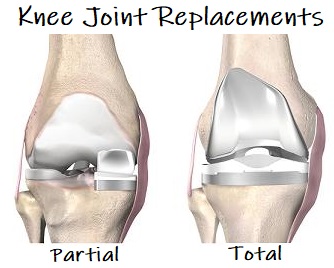
Knee joint replacement involves replacing part or all of a knee joint that has been damaged or worn away with a prosthesis - a new joint made of metal and plastic.
The aim of a knee replacement is to reduce pain from arthritis and improve function.
Knee replacement surgery is the most common joint replacement surgery performed. There are about 80,000 knee replacements carried out per year in the UK and 130,000 in the US.
Do I Need A Knee Replacement?
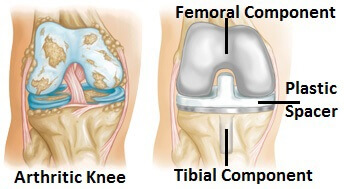
Knee joint replacements are most commonly carried out to treat advanced osteoarthritis of the knee. This is when the cartilage lining the joint becomes damaged and wears away, causing pain and limiting function.
The knee joint is where the ends of the thigh and shin bone meet. Each bone is lined with cartilage which allows them to glide smoothly over each
other.
With osteoarthritis, the cartilage thins and the bone underneath begins to thicken laying down new bony spurs, called osteophytes. As arthritis progresses, the cartilage can wear away altogether and you get bone rubbing on bone.
Arthritis pain can end up so severe that normal daily activities such as walking and going down stairs become extremely painful and difficult. The knee can even become deformed. When this happens, the best course of action is knee joint replacement.
Indications for Knee Replacement
People are often unsure at what stage of arthritis surgery is appropriate. There are no hard and fast rules but the following criteria are a good guideline:
- The pain is affecting your normal daily activities e.g. walking, stairs
- The pain is affecting your sleep e.g. frequently keeps you awake or wakes you up
- You have tried exercises to strengthen your knee for a reasonable period with no effect
- You are in severe pain
If your symptoms are not as severe as these, a knee joint replacement is probably not needed and other treatment methods are more appropriate.
Some people worry about leaving it too long before having a knee replacement. Rest assured, there is no need to worry. Arthritis does not get to a stage where it is so bad that the surgery can’t be performed, so there is no harm in waiting.
However, if by waiting you are losing lots of strength in your muscles from not being able to keep active, it is likely to take you longer to recover after surgery. Visit the Arthritis section to find out more including treatment options for arthritis.
Types Of Knee Joint Replacement
Knee joint replacements were first carried out in the 1940’s and have developed significantly since then. There are two types of knee replacement:
1. Partial Knee Replacement
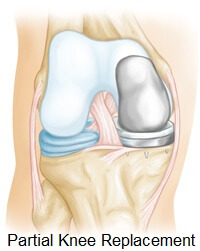
A partial knee joint replacement it where one side of the knee joint is removed and replaced with a metal and plastic prosthesis.
It is sometimes known as a Unicompartmental Knee Replacement (UKR) or Unicondylar Knee Arthroplasty.
A partial knee joint replacement is most commonly performed on the inner side of the knee as that is the most common part of the joint affected by arthritis.
If there is also arthritis at the kneecap then the back of the patellar and front surface of the thigh bone can be replaced too - visit the patellofemoral arthritis section to find out more.
2. Total Knee Replacement
With a total knee joint replacement, the entire knee is replaced. All the bone and cartilage at the bottom of the thigh bone (femur) and at the top of the shin bone (tibia) are removed.
The whole knee joint is then replaced with a prosthesis (implant) made of metal and plastic. This procedure is also known as a TKR or Total Knee Arthroplasty.
You can even watch video footage of knee replacement surgery so you can see exactly what goes on!
But let's start by looking at the indications and alternatives to knee replacement surgery. We will the go on to look at what happens during surgery, the rehab process, common problems associated with surgery and the recovery process.
Alternatives to Surgery
Beat Knee Arthritis

All the info you need about knee arthritis, top tips, exercises & loads more.
Rated 4.4/5
Find Out More
 |

|

Most people with osteoarthritis do not require a knee joint replacement. Arthritis pain can often be successfully managed without the need for surgery, by using treatments such as exercises, pain relief, PRICE and injections.
If you want to know more, visit the Knee Arthritis Treatment section for more information on effective ways to treat osteoarthritis of the knee.
Knee joint replacement is only performed when arthritis has become advanced and non-surgical treatments are no longer adequately controlling the pain, or when function is serious inhibited.
If treatment is not working anymore, there are some simpler operations that can be effective:
- Knee Arthroscopy: Key-hole surgery where damaged parts of cartilage are removed
- Osteotomy: Where a small amount of diseased bone is removed
You can find out more about the surgery itself, the rehab and recovery process, common problems associated with knee replacements and frequently asked questions by clicking the appropriate link below, depending on which type of surgery you are interested in:
Find Out More
You can find out loads more about total knee replacements and partial knee replacements in our dedicated sections, including what happens during surgery, the recovery process, common problems and answers to frequently asked questions regarding knee replacements.
You can also check out our book Knee Arthritis: Take Back Control. It is the top rated book on Knee Arthritis on Amazon with an average user review rating of 4.4/5. It's packed full of great information from exercises to knee replacements and everything in between. A perfect guide for anyone who is having a knee joint replacement
Page Last Updated: 11/01/23
Next Review Due: 11/01/25
Related Articles



Check Out Our Book!


|
|
This site complies with the HONcode Standard |

Our Awards

Visitor Comments
“This is one of the best self-help & info sites of any medical condition I've ever seen. Excellent work.” Amy, UK
"Your site and exercises have been a lifesaver! The explanations are so clear. Thanks for your help and excellent work." Claire, US
"Your website is a gold mine, thank you very much."
Gavril, Denmark
"I LOVE your website. Out of all the others, yours is so informational and easy to read." Michelle, US
"This is the best site dealing with knee problems that I have come
across. I will be putting the stretches and exercises into practise. Thank you!"
Margaret, S. Africa
"Brilliant website - highly recommended! And as nurse (25yrs exp) its written expertly and is very explanatory and easy to understand. Thank you!" Jo, UK


The material on this website is intended for educational information purposes only. It should not substitute or delay medical advice, diagnosis or treatment.
Knee-Pain-Explained.com is a trading name of Wilson Health Ltd. All rights reserved. Terms & Conditions apply
© knee-pain-explained.com 2010-2024. Last updated 25th April 2024
Contact Us About Us Blog Privacy Policy Advertising Policy Sitemap
