- Home
- Common Knee Injuries
- Meniscus Tear
Meniscus Injury
Written By: Chloe Wilson, BSc(Hons) Physiotherapy
Reviewed by: KPE Medical Review Board
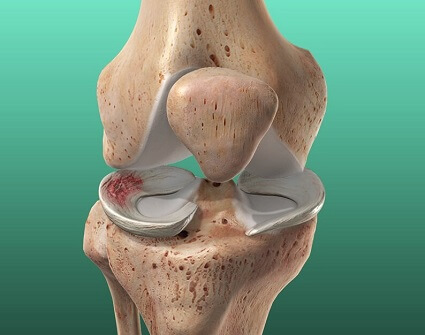
A meniscus injury develops when there is damage to the special cartilage that lines the knee joint.
Meniscus tears may develop suddenly due to an injury, or come on gradually over time due to wear and tear.
The most common meniscus tear symptoms are knee pain, swelling, stiffness, instability and sometimes locking - where the knee gets stuck.
It can take a long time to recover from a torn meniscus as the blood supply to the region is generally poor, resulting in slow healing.
Here, we will look at the causes and different types of cartilage injuries as well as common meniscus tear symptoms and treatment options.
Knee Meniscus Anatomy
The knee meniscus is made up of thick, crescent shaped bits of cartilage that line the knee on either side of the joint.
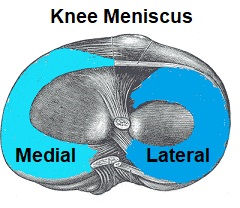
There are two parts, the medial
meniscus, on the inner side of the knee and lateral meniscus, on the
outer side of the knee.
The meniscus acts as a shock absorber and ensures there is correct weight distribution through the knee.
Medial meniscus tears are the most common as more force tends to go through the inner side of the knee, resulting in medial knee pain.
Causes of a Meniscus Injury
A meniscus injury may be caused by:
1. Knee Injury
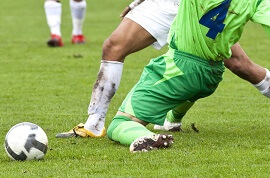
A meniscus injury usually happens during sporting activities e.g. football, rugby and skiing.
Meniscus tears typically occur when the foot is fixed, e.g. studs in the ground, and the knee is slightly bent and then twisted by a sudden turn initiated either by you or by a force to the outside of the knee.
Medial meniscus tears are more common than lateral meniscus tears and often the medial collateral ligament (MCL) is injured at the same time – see MCL Tear.
2. Wear & Tear
Wear and tear at the knee joint associated with aging can also cause a meniscus injury. Cartilage tends to become more brittle with age and everyday use of the knee can result in meniscus tears. Often this affects the edges of the meniscus which get frayed and torn.
Symptoms of meniscus wear and tear may gradually build or they may be triggered by a particular event e.g. twisting the knee awkwardly. Meniscal tears are also a common feature of knee arthritis.
Types of Meniscus Tears
There are a few different types of tears that can occur with meniscus injuries which you can see illustrated below:
- Normal Meniscus: shows what a normal meniscus looks like
- Vertical/Longitudinal Tear: This is when the tear is located along the length of the meniscus. It can be referred to as either a vertical tear or a longitudinal tear
- Bucket Handle Tear: A bucket handle meniscus tear is where part of the cartilage tears away from its insertion to the tibia. This results in a loose flap of cartilage that can move
- Transverse/Radial Tear: A transverse meniscus tear (also known as a radial tear) starts at the outer edge of the cartilage and comes inwards
- Degenerative Changes: This is where the cartilage wears away losing its smooth surface becoming brittle and thin. It is usually associated with aging

The type, location and size of meniscus injury can affect both the symptoms and the healing time.
Meniscus Tear Symptoms
The three most common meniscus tear symptoms are:
1. Knee Pain
The most obvious meniscus tear symptoms is knee pain. With a meniscus injury there is often a lot of pain in the knee, especially when trying to straighten the leg fully or when bearing any weight though it. Activities such as coming down stairs and squatting down are often painful.
If you can do a full squat, where your buttocks touch your heels, and there is no pain, it is unlikely you have a cartilage problem. As most meniscus injuries affect the medial knee meniscus, they frequently cause medial knee pain.
2. Knee Swelling

Another common symptoms with meniscus injuries is knee swelling. The swelling usually develops gradually over the first 48 hours after a meniscus injury. The amount of swelling will depend on the severity and location of the injury.
If there is ongoing wear and tear in the meniscus, then the amount of swelling will often fluctuate. A meniscus injury is a common cause of knee swelling.
3. Knee Locking
One of the most definitive meniscus injury symptom is locking which can occur with more severe tears. This is where the knee joint gets stuck in one position and can’t move. A meniscus tear is the most common cause of a locked knee.
There are two different types of knee locking:
- True Locking: this is where something
gets stuck inside the knee joint, usually a small fragment of
cartilage (see bucket handle tear above). Often, if you move the leg
around for a bit, the knee then unlocks as the cartilage fragment moves
out of the way
- Pseudolocking: this usually occurs due to pain. If performing a movement is particularly painful, the body will often prevent itself from moving further to try and make sure no more damage is done.
If you don't have any of these meniscus tear symptoms, it is unlikely that you have a cartilage injury. Visit the knee pain diagnosis section for help working out what else may be causing your pain.
Meniscus Injury Treatment
Meniscus injury treatment usually consists of:
1. PRICE
PRICE is the best place to start for the first few days after a mensicus injury before moving on to a rehab programme to strengthen the knee and regain any loss of movement
and function. PRICE stands for Protect, Rest, Ice, Compress and Elevate.
Visit the PRICE treatment section to find out how to use the different elements safely and effectively.
2. Meniscus Tear Exercises
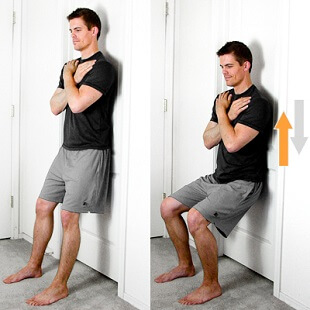
Exercises are a really important part of meniscus tear treatment, both to help with recovery and to reduce the chance of ongoing problems.
Building up the strength of the muscles surrounding the knee joint helps to reduce the amount of weight going through the knee and therefore through the cartilage, and can really help to reduce the effect of a meniscal tear.
Muscle weakness of the glutes and kneecap muscles often causes excess force to go through the medial meniscus resulting in an injury, so strengthening these muscles can particularly help.
In the meniscus injury exercises section you will find some great exercises that can really help with your meniscus tear recovery.
3. Ice
Ice can really help to reduce the pain and swelling associated with a meniscus injury which helps to speed up healing. By reducing the inflammatory response, you reduce the density of inflammatory chemicals that irritate the torn meniscus, making it easier for it to heal. But when used incorrectly, ice can actually make things worse.
Visit the ice treatment section for the most effective ways to apply ice.
4. Tubigrip
Tubigrip is an elasticated compression bandage that can help to reduce swelling and to provide some support to the knee after a meniscus injury. However, long term use of tubigrip is not advised as it can result in weakening of the muscles.
Visit the tubigrip compression section to find out more about how it works and how to get the right size for you.
5. Knee Brace
Knee braces provide much more stability than tubigrip, so can be really useful after a meniscus injury, especially if the knee feels unstable.
Usually a basic or advanced knee brace will provide enough support. However, if your meniscus injury is associated with a ligament tear and there is significant instability, then you may need an Elite brace.
6. Knee Meniscus Surgery
If exercises haven’t resolved your meniscus tear symptoms, your doctor may advise surgery. Most surgery for a meniscus injury is performed arthroscopically (keyhole surgery). This is where they make two or three small holes around the knee and a camera is inserted into the knee.
The surgeon will remove
any debris (torn bits of cartilage) and sew up tears where possible as shown in the video here from the American Academy of Orthopedic Surgeons.
The aim is to preserve as much of the
cartilage as possible since it won’t regrow. You can usually go home the same day.
Following meniscus injury surgery, it is important to exercise to regain full strength, movement and balance at the knee.
Recovering From A Torn Meniscus
Unfortunately, torn knee cartilage is not very good at regenerating. Tissues require a good blood supply to heal and whilst blood capillaries do feed the outer edges of the meniscus, the central parts of the meniscus are avascular (have no blood supply). This means that often meniscus tears can’t properly heal.
But by building up the strength of the knee muscles, you can really reduce the symptoms of a meniscus injury and reduce the risk of further damage to the meniscus. Check out our Meniscus Injury Exercises >
Meniscus Injury Summary
Meniscus tears are a common knee problem, especially in sports or as we get older. Common symptoms of a meniscus injury include knee swelling, pain, stiffness, and instability. It can be difficult to move the knee or put weight on it, and some people may experience a popping sound when the injury occurs.
Meniscus injuries can vary in severity and often depend on the type of tear, where it is located in the knee, the activity that caused it, and the patient's age. Recovery times can also vary and may require a combination of rest, physical therapy, and, if necessary, surgery.
The best way to prevent the cartilage from getting torn is to strengthen the knee muscles so the knee is well supported and less weight goes through the joint. If a meniscus injury isn’t sounding quite like your knee pain, visit the Knee Pain Diagnosis section for help working out what is wrong.
You might also be interested in the following articles:
- Front Knee Pain
- Side Knee Pain
- Burning Knee Pain
- Knee Range Of Motion
- Knee Pain On Stairs
- Knee Pain & Popping
- Swollen Knee Treatment
Page Last Updated: 16/03/23
Next Review Due: 16/03/25
Related Articles

Check Out Our Book!

Visitor Comments
“This is one of the best self-help & info sites of any medical condition I've ever seen. Excellent work.” Amy, UK
"Your site and exercises have been a lifesaver! The explanations are so clear. Thanks for your help and excellent work." Claire, US
"I LOVE your website. Out of all the others, yours is so informational and easy to read." Michelle, US
"This is the best site dealing with knee problems that I have come
across. I will be putting the stretches and exercises into practise. Thank you!"
Margaret, S. Africa
"Brilliant website - highly recommended! And as nurse (25yrs exp) its written expertly and is very explanatory and easy to understand. Thank you!" Jo, UK
The material on this website is intended for educational information purposes only. It should not substitute or delay medical advice, diagnosis or treatment.
Knee-Pain-Explained.com is a trading name of Wilson Health Ltd. All rights reserved. Terms & Conditions apply
© knee-pain-explained.com 2010-2026. Last updated 30th September 2026
Contact Us About Us Blog Privacy Policy Advertising Policy Sitemap
