- Home
- Common Knee Conditions
- Osgood Schlatters
- Strengthening Exercises
Osgood Schlatters Exercises
Written By: Chloe Wilson, BSc(Hons) Physiotherapy
Reviewed by: KPE Medical Review Board
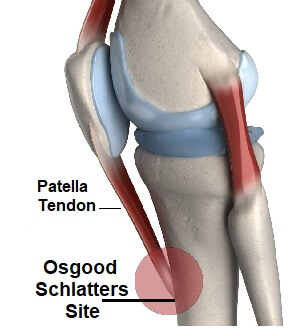
Osgood Schlatters disease is a common knee problem caused by irritation of the bone just below the kneecap which leads to pain and inflammation.
It is most common in adolescents, tending to occur after a sudden growth spurt, and is usually associated with muscle weakness and tightness.
Recovery from Osgood Schlatters can take anything from a couple of weeks to two years, depending on how well it is treated.
Exercises are one of the key features of treatment for Osgood Schlatters Disease, and it is important to both strengthen and stretch the knee muscles, particularly the quadriceps. Here we will look at some of the best strengthening exercises for Osgood Schlatters and then go on to look at what stretches can help too.
If you want to find out more about the causes, symptoms and other treatment options available, visit the Osgood Schlatter Overview.
Why Are Exercises Important?
Muscle weakness is a common feature of Osgood Schlatter Disease and can actually make the condition worse.
When there is muscle weakness, it changes the way the forces go through the knee, putting more pressure through the knee bones. It also means that the other muscles have to work harder to compensate, and they can end up developing problems.
It is therefore really important to do strengthening exercises for Osgood Schlatters Disease not only to treat it but to prevent it from recurring.
Osgood Schlatters Strengthening
Here you will find some simple strengthening exercises that can really help Osgood Schlatters Disease. Once you have got to grips with these, I suggest you also start doing some stretching exercises to speed up your recovery.
1. Bridging
Purpose: Strengthens the hamstrings whilst also working the quads and buttock muscles. A great all-round exercise
Starting Position: Lie on your back with both knees bent about 90° and your feet on the floor/bed
Action: Clench your buttocks and lift your bottom off the bed as high as you can without arching your back. Hold for 3-5 seconds and slowly lower
Repetitions: Repeat 10-25 times, 1-2x daily
Note: a. Keep your back straight – don’t let it arch as you lift up, it should be your bottom doing the work
b. Don’t hold your breath – keep breathing normally
c. Don’t let your knees drop out – imagine you are trying to hold a tennis ball between your knees
Progression: Use a resistance band looped around your knees or over your thighs to make the exercise harder
2. The Football – Stage 1
Purpose: Increase the muscles on the inside of your knee that are responsible for how the kneecap moves, also increases knee stability, commonly lacking with Osgood Schlatters
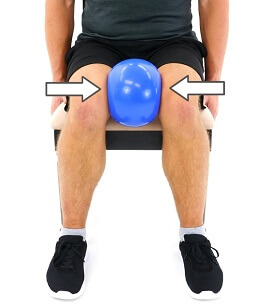
Starting Position: Sit in a chair, feet hip width apart with a soft/foam football in between your knees.
Action: Clench your buttocks, clench your knees and gently squeeze the ball with your knees. Hold for 3-5 secs and relax
Repetition: Repeat 10-20x, 2x daily
Tips: a. Place your fingers on the muscles on the inside of the knee and feel
the muscle tighten underneath you to check you are doing it right
b. When you squeeze the ball, make sure the squeezing movement comes from your knees, not your hips
Note: If you don’t have a foam football, you could use a folded up pillow
3. The Football – Stage 2
Purpose: Further strengthening of the muscles on the inside of your knee that control the kneecap moves. Also increases knee stability
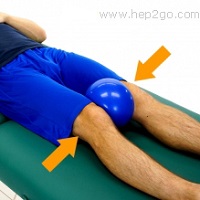
Starting Position: Lying
on your back with you feet hip width apart with a soft football in between your knees
Action: Squeeze the football as with stage 1 (clench buttocks and knee muscles). Hold for 3 secs and slowly relax
Repetition: Repeat 10-20x, 2x daily
Progression: Place a pillow under your knee's so they are bent 30°. Squeeze the ball and then maintaining the squeeze, lift your foot up off the bed to straighten the knee. Hold for 3 seconds, slowly lower and finally relax the squeeze on the ball
Note: a. Ensure that you keep squeezing the ball throughout the exercise – keep the knee and buttock clench going throughout.
b. Keep the knee resting on the pillow – do not lift it up
RELATED ARTICLE: VMO Exercises>
4. Straight Leg Raise
Purpose: Strengthen the Quads muscles without bending the knee NB not suitable if you have a history of back problems
Starting Position: Lying flat on your back. Leg and knee straight
Action: Pull your toes towards you and tighten/clench the muscle on the front of the thigh, locking your knee straight. Lift your foot up about 6 inches off the bed. Hold for 3-5 secs and slowly lower. Ensure your knee stays straight the whole time
Repetition: repeat 10-20 times, 2x daily
Progression: Add a weight e.g. a shoe or ankle weight.
5. The Clam
Purpose: Strengthen the buttock muscles (glutes) to help support the knee and prevent excessive weight going through the inner side of the knee – a must for anyone with Osgood Schlatters!
Starting position: Lie on your side with your hip and knees bent approx 90°, feet together.
Action: Keeping your feet together, lift the top knee up as high as you can. Hold for 3 seconds and slowly lower
Repetition: Repeat 10-25x on each side, 2x daily
Note: Do not let your top hip roll backwards
What Else Can Help?
If you want to know more about Osgood-Schlatters Disease including more information on its causes, presentation and other treatment options, go to the Osgood Schlatter overview page.
If you haven't already visited the stretches for Osgood Schlatters Disease page, I would highly recommend it, as muscle tightness is one of the key causes of the disease.
Page Last Updated: 12/12/23
Next Review Due: 12/12/25
Related Articles
Check Out Our Book!

|
|
This site complies with the HONcode Standard |

Visitor Comments
“This is one of the best self-help & info sites of any medical condition I've ever seen. Excellent work.” Amy, UK
"Your site and exercises have been a lifesaver! The explanations are so clear. Thanks for your help and excellent work." Claire, US
"Your website is a gold mine, thank you very much."
Gavril, Denmark
"I LOVE your website. Out of all the others, yours is so informational and easy to read." Michelle, US
"This is the best site dealing with knee problems that I have come
across. I will be putting the stretches and exercises into practise. Thank you!"
Margaret, S. Africa
"Brilliant website - highly recommended! And as nurse (25yrs exp) its written expertly and is very explanatory and easy to understand. Thank you!" Jo, UK


The material on this website is intended for educational information purposes only. It should not substitute or delay medical advice, diagnosis or treatment.
Knee-Pain-Explained.com is a trading name of Wilson Health Ltd. All rights reserved. Terms & Conditions apply
© knee-pain-explained.com 2010-2024. Last updated 27th February 2024
Contact Us About Us Blog Privacy Policy Advertising Policy Sitemap
